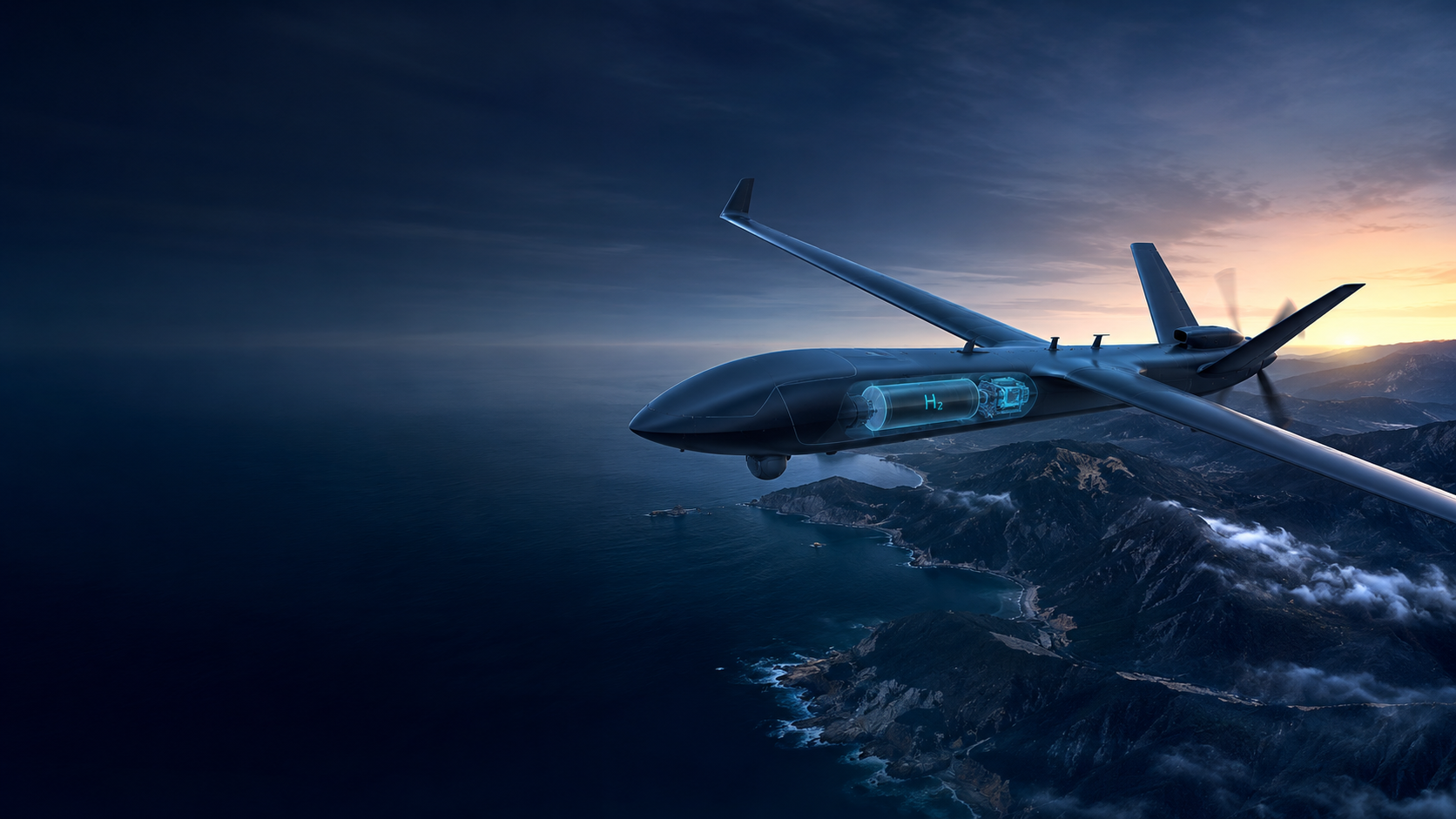

US-owned hydrogen-electric power systems for Group 1–2 uncrewed aircraft
Add endurance.
Not hydrogen complexity.
A qualified hydrogen-electric power and readiness system for persistent uncrewed aircraft. Endurance becomes a purchasable aircraft capability, not an internal hydrogen development program.
Target aircraft class: 15–35 kg MTOM, 0.8–1.2 kW cruise power.
700W
Continuous reference load
12h
Reference endurance
8.4kWh
Energy delivered
Image: concept illustration. Not a delivered configuration.
Problem
Battery mass closes the mission before design review.
Endurance requirements convert directly into stored energy. At battery specific energy, that mass consumes the payload budget and the design loop ends before it starts.
Reference mission · 700 W continuous · 12 h · 8.4 kWh
Battery only
220 Wh/kg at pack level
≈38kg
Hydrogen hybrid
Preliminary sizing range
18–22kg
16–20 kg
mass recovered against the battery-only case, available to payload, fuel fraction or additional time on station.
Preliminary. Battery mass derived from 8.4 kWh delivered at 220 Wh/kg pack level — a deliberately favorable assumption for the battery case. Cell-level figures are higher; installed pack mass after structure, BMS and wiring is typically lower. Hydrogen hybrid sizing is preliminary and requires mission inputs: duty cycle, transient power, reserve policy, temperature and altitude.
Outcome 01
More payload, or more mission time.
Recovered mass is spent where the program needs it: sensors, comms relay, or additional hours on station.
Outcome 02
Refuel in minutes, not hours.
Cylinder exchange replaces charge cycles, so sortie rate is set by crew procedure rather than battery recovery time.
Applicability
Group 1–2 fixed-wing and VTOL aircraft, 15–35 kg maximum take-off mass, 0.8–1.2 kW cruise power, 8–20 hour endurance requirements. Outside that band, tell us the mission anyway — the sizing method is the same and we will say plainly whether hydrogen closes it.
Solution
Three elements. One accountable supplier.
We deliver the airborne system, the ground support required to operate it, and an optional field hydrogen source when logistics demand it.
Airborne
Qualified endurance system
Fuel-cell module, hydrogen storage, hybrid battery, controller and installation kit, integrated and qualified as one aircraft power system.
Ground
Cylinder support package
Certified prefilled cylinder exchange, handling equipment, digital tracking and refuel procedures for sustained sortie rates.
Optional
Field hydrogen module
Partner electrolysis, purification and certified compression for sites where cylinder delivery logistics fail.
The alternative
Doing this in-house is a two-year program and a permanent function.
Buying a fuel-cell module is straightforward. Everything that turns it into a qualified aircraft capability is not — and most of it does not end when the program does.
What in-house integration requires
Hydrogen safety engineering
Hazard analysis, zoning, vent path design, leak detection strategy and emergency-state logic. A specialist discipline, hired or contracted.
A permitted hydrogen test facility
Ventilation, gas detection, interlocks and jurisdiction-specific permitting. Typically three to six months before the first bench test runs.
Certified storage sourcing and compliance
Cylinder selection, certification review, service-life tracking and periodic inspection — a regulatory obligation you own for the life of the fleet.
Environmental and EMI qualification
Altitude, thermal, vibration, shock and EMC campaigns against agreed test levels, plus the test-house calendar to run them.
Fault-injection and safe-state development
Every failure mode exercised and evidenced, not argued.
Configuration control and evidence management
A standing function, not a project deliverable. It outlives the integration.
We have built this once so your team does not have to build it at all — and every airframe we qualify makes the next one faster and cheaper.